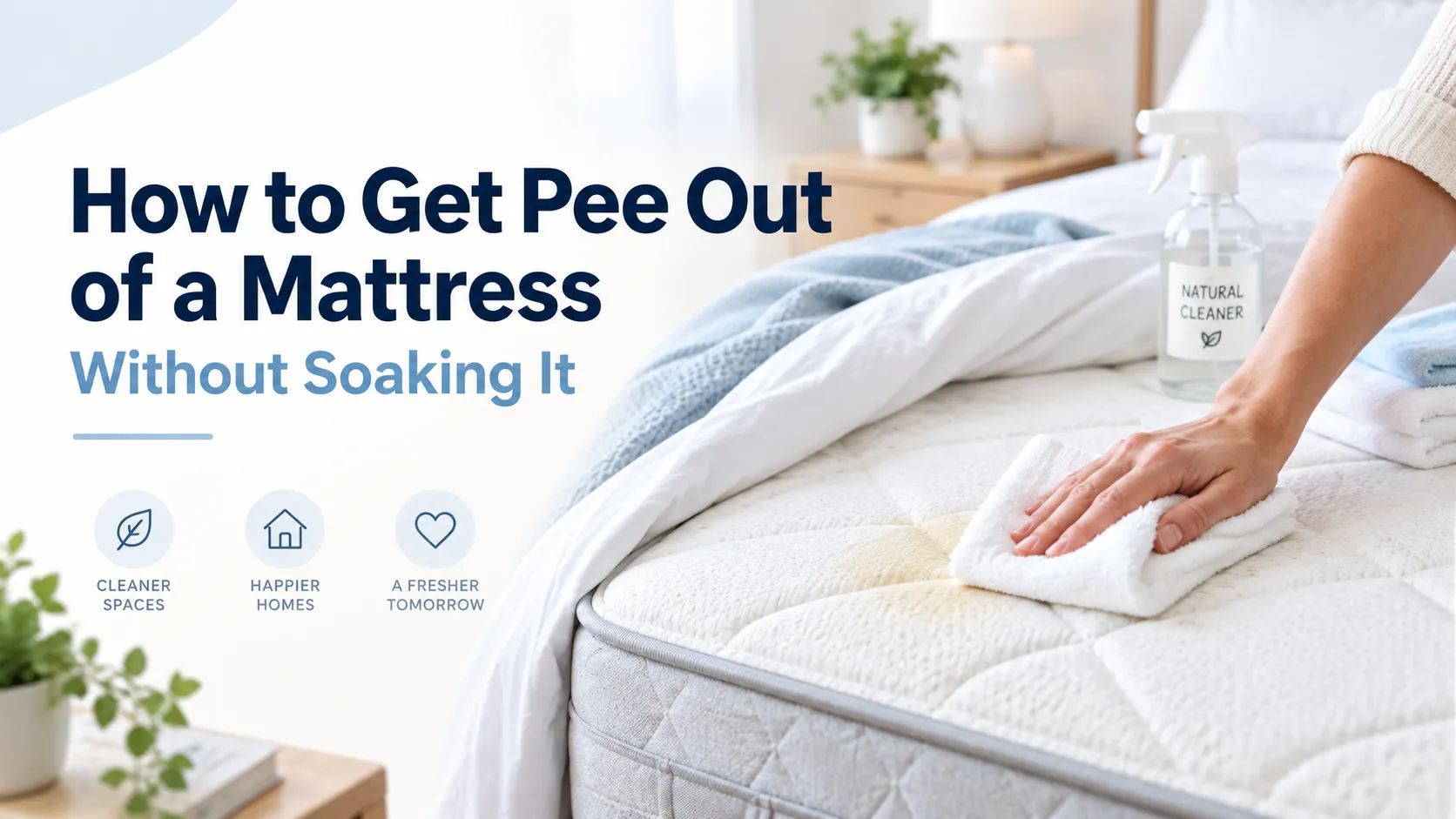
If the urine is still wet, start by removing as much liquid as possible rather than reaching for a cleaning mixture. Strip the bedding and press clean, absorbent towels into the spot. Blot instead of rubbing, changing towels as they become damp.
After that first response, the best method depends on what remains. A fresh human accident, an old urine stain, pet odor, and a memory-foam mattress do not all call for the same treatment. The safest approach is to use the least moisture necessary, follow the mattress-care instructions, and judge the result only after the treated area has dried completely.
What to Do While the Urine Is Still Wet
Fresh urine is easier to manage before it moves farther into the mattress. The immediate goal is absorption, not deep cleaning.
Use this order:
- Remove all affected bedding. Take off sheets, blankets, mattress pads, and any washable protector. Clean those items separately according to their care labels.
- Blot with dry towels. Press clean absorbent towels into the wet area and replace them as they pick up moisture.
- Avoid rubbing. Scrubbing can spread moisture across a larger section of the mattress instead of removing it.
- Keep the treatment area contained. Do not pour cleaner over a wide area simply because the visible wet spot is large.
- Check the mattress-care instructions. Find out whether the cover or inner material has restrictions on water, cleaners, or spot treatment.
If a large amount of urine reached the mattress, continue blotting until the towels are picking up much less moisture. Adding cleaning solution while the area is still heavily saturated usually creates more liquid that must later be removed and dried.
Once the excess is gone, choose the next step based on the condition of the stain and the mattress material.
Match the Treatment to the Situation
A quick decision before cleaning can prevent unnecessary wetting or repeated treatments.
| Situation | First priority | Treatment direction | Main caution |
|---|---|---|---|
| Fresh human urine | Remove liquid | Compatible spot cleaner | Avoid saturating the mattress |
| Dried urine stain | Check stain and odor separately | Targeted treatment | Do not soak the area to make it “fresh” again |
| Cat or dog urine | Remove moisture and address odor | Urine-specific enzyme cleaner when compatible | Follow the cleaner label |
| Memory foam or specialty foam | Limit added moisture | Manufacturer-approved spot care | Generic soaking methods may be unsuitable |
| Odor remains after drying | Treat the remaining odor source | Compatible urine treatment | Reassess only after the mattress dries again |
This distinction is more useful than choosing a cleaner first. A fresh spot still contains removable liquid, while a dried mark needs targeted cleaning rather than more absorption. Pet accidents often benefit from a product formulated for urine, and some foam mattresses have much stricter moisture limits than other designs.
Clean a Fresh Urine Spot With Minimal Moisture
After blotting, treat only the affected surface. The exact cleaner should be one that the mattress manufacturer or care label permits.
Apply a small amount rather than soaking the fabric. Work over the spot with a clean cloth, then press a dry towel into the same area to lift moisture and residue. Repeat a controlled treatment only when the first pass is clearly removing material from the surface.
A simple process looks like this:
- Choose a cleaner that is compatible with the mattress cover and inner material.
- Apply enough to dampen the affected area without flooding it.
- Blot the spot with a clean cloth or towel.
- Switch to a dry towel and press out as much moisture as possible.
- Allow the mattress to dry completely before deciding whether another treatment is necessary.
Some mattress-care guides permit vinegar-based spot cleaning, but that does not make one vinegar ratio appropriate for every mattress. If your manufacturer specifically allows it, follow those instructions rather than relying on a universal household recipe.
The same principle applies to stronger stain removers. More aggressive chemistry is not automatically a better choice for a fresh accident, especially when the visible stain may disappear after basic spot cleaning and drying.
Treat a Dried Urine Stain and Lingering Smell
A dried urine mark needs a different approach because there is no longer a pool of liquid to absorb. Start by determining whether the main problem is discoloration, odor, or both.
When the stain is still visible
Use a compatible spot cleaner on the discolored area rather than soaking a large section of the mattress. Apply it according to the product or mattress-care instructions, then blot the treated surface instead of scrubbing.
Let the mattress dry before deciding whether the treatment worked. A stain may look different while the fabric is damp, and repeatedly adding cleaner before the first application has dried can make the mattress harder to dry without improving the result.
If the mark becomes lighter after drying, another limited treatment may be reasonable if the product directions permit it. If the appearance stops changing, avoid escalating to harsher scrubbing without checking the manufacturer’s guidance.
When the smell remains
Odor that is still obvious after the mattress is dry calls for a treatment aimed at urine residue rather than another general wash.
A urine-specific enzyme cleaner can be useful, particularly for pet accidents, provided it is compatible with the mattress surface. Follow the product label for application amount, contact time, and drying. Different enzyme products are formulated differently, so a single homemade timing rule is not appropriate.
Do not layer several cleaners over one another. Finish one treatment, remove any residue as directed, and let the mattress dry before deciding what to try next.
Handle Cat or Dog Urine as a Separate Case
The first response to fresh pet urine is still absorption. Remove the bedding and blot the wet area before applying another product.
Once most of the moisture is out, consider a cleaner specifically labeled for pet urine. Enzyme-based products are commonly used for organic pet stains and odors because they are designed for that type of soil. The cleaner still has to be suitable for the mattress material, so both the mattress instructions and product label matter.
For a pet accident, focus on these questions:
- Is the area still wet or already dry?
- Does odor remain after drying?
- Is the cleaner labeled for urine and compatible with upholstery or the mattress surface?
- How much product does the label instruct you to use?
- Can the mattress dry fully before it is covered again?
There is usually no need to invent a different household mixture for cat urine and dog urine. The condition of the spot, the depth of the contamination, and the mattress construction are more useful guides.
Never mix bleach with ammonia or other household cleaners. Mixing cleaning chemicals can create dangerous fumes, so use one compatible product at a time.
Be More Careful With Memory Foam
Memory foam and other specialty foams deserve extra caution because some manufacturers place strict limits on how much moisture their materials should receive.
For example, TEMPUR advises against washing or soaking its proprietary foam. That does not mean every foam mattress follows the same care rules, but it shows why generic instructions to saturate a urine stain are unreliable.
Before wet cleaning a foam mattress:
- check whether the outer cover is removable;
- follow the cover’s own laundering instructions if it can be washed separately;
- find out whether the foam itself may be spot cleaned;
- use the smallest practical amount of liquid;
- blot out added moisture as you work;
- allow the treated area to air-dry completely.
Do not assume that instructions for the removable cover also apply to the foam core. The two materials may have very different care requirements.
If an approved spot treatment does not solve the problem, consult the manufacturer’s guidance before repeating a wet process. Adding more liquid is not necessarily the right next step.
Dry the Mattress Completely
Drying is part of urine removal, not an optional final detail.
After treatment, press clean dry towels into the area to remove as much remaining moisture as possible. Then increase airflow around the mattress. A fan directed across the surface can help, and normal room ventilation supports evaporation.
Do not replace sheets, a protector, or other bedding while the treated section is still damp. Covering the area slows drying and makes it harder to judge whether odor has actually been removed.
Avoid relying on a universal drying time. The amount of liquid used, mattress construction, room temperature, airflow, and humidity all affect how long the process takes.
Once the mattress is completely dry, evaluate the result:
- Has the visible stain disappeared or become substantially lighter?
- Is the urine odor gone or clearly reduced?
- Does the treated section need another limited treatment?
- Is the mattress dry enough to cover and use normally?
If a strong smell becomes noticeable again only after drying, a compatible urine-specific treatment is more logical than repeating a general cleaner.
If the mattress was heavily saturated or you cannot get it fully dry, check the manufacturer’s care guidance before adding more liquid or continuing repeated home treatments.
Prevent the Next Accident From Reaching the Mattress
A washable waterproof mattress protector can make future urine accidents much easier to manage. It creates a removable barrier between the spill and the mattress, so much of the cleanup can be handled by laundering the protector and bedding instead of treating the mattress itself.
Choose a protector that fits properly and does not conflict with the mattress manufacturer’s care requirements. Keeping a spare protector and clean sheet available can also reduce the temptation to remake the bed before a wet mattress has finished drying.
The key sequence is straightforward: remove fresh urine first, add as little cleaning moisture as necessary, use a urine-specific treatment when odor remains, and give foam materials extra caution. Let the mattress dry completely before deciding whether another cleaning pass is actually needed.
FAQ
How do you get pee out of a mattress if it is still wet?
Remove the bedding and blot the area with clean, absorbent towels until they pick up much less moisture. Avoid rubbing, then use a compatible spot cleaner without soaking the mattress.
How do you get dried pee out of a mattress?
Treat the remaining stain with a cleaner allowed by the mattress manufacturer, blot the area, and let it dry completely before deciding whether another treatment is needed. Avoid re-soaking the mattress just to make an old stain wet again.
How do you get pee smell out of a mattress?
If odor remains after the mattress is fully dry, use a urine-specific treatment that is compatible with the mattress surface. Enzyme cleaners are commonly used for urine odors, especially from pets, but the product label and mattress-care instructions should guide application.
Can you use vinegar to get urine out of a mattress?
Some mattress manufacturers allow vinegar-based spot cleaning, but there is no universal vinegar mixture that is suitable for every mattress. Check the care instructions first, particularly for foam and specialty materials.
How do you get cat or dog pee out of a mattress?
Blot fresh pet urine first, then use a cleaner labeled for pet urine if it is compatible with the mattress. An enzyme-based product may help with lingering odor. Let the mattress dry completely before judging whether another treatment is necessary.